Friday, November 8, 2013

Journey of A Thousand Miles: We've Only Just Vigan

Back in August, Filipinos for Life Speakers and Trainers were invited by the Archdiocese of Nueva Segovia in Vigan to do a series of talks for their youth. Last Saturday, F4L members Rommel Lopez, Anna Cosio, and Juan Carlo Vitasa, and I went on the long trip to Vigan to respond to the call of evangelizing the young through the Gospel of Life. This is an account of the work we did in several schools spanning three days.


Day 1: The Arrival

On our way to the Great Vigan Adventure. 10 PM, Maria de Leon Bus Terminal, November 2.

We arrived in Candon City, Ilocos Sur around 4 AM, way earlier than we were expected to arrive by our host, Fr. Willie Jones Ducusin. Fr. Ducusin is also the superintendent of the Nueva Segovia Association of Catholic Schools. It was a good thing that Candon has a 24-hour McDonald’s restaurant where we waited for Fr. Willie. He promptly arrived before 5 AM, and escorted us to the rectory of the St. John de Sahagun Parish Church where we freshened up, had breakfast, and heard mass.

Rommel and I posing in front of St. John de Sahagun parish

This was at the Sta. Maria Church, a UNESCO World Heritage Site, on top of a hill

At Sta Maria Church


White-sand beach along the road going to Vigan, our destination. 

Mountains and hills everywhere you look! 
Another beach! But this time it's a rocky one, quite unsuitable for bathing.

This is the Arzobispado of Vigan where we were stationed for a couple of days. Looks really old, because it is! 
We spent the rest of the day enjoying the sights and heritage spots of Ilocos Sur. Highlights of the day were our visit to Sta. Maria Church, a UNESCO World Heritage site and a church built atop a hill much like forts of medieval times; the zoo owned by former governor Chavit Singson called “Balwarte”. We had an idea of how rich Chavit Singson was through Balwarte, as the money involved to procure the animals and maintain the zoo itself costs an unimaginable amount of money.

praying before the tomb of Bishop Verzosa, grand father of Sr. Pilar. 


The inside of the Arzobispado. I miss all that wood. 

At Chavit's Balwarte

Trying out Vigan's yummy Empanada! 

another view of the Arzobispado from the inside.

Me during the Animal Show at the Balwarte

I wonder how much money does it cost to maintain this place. 

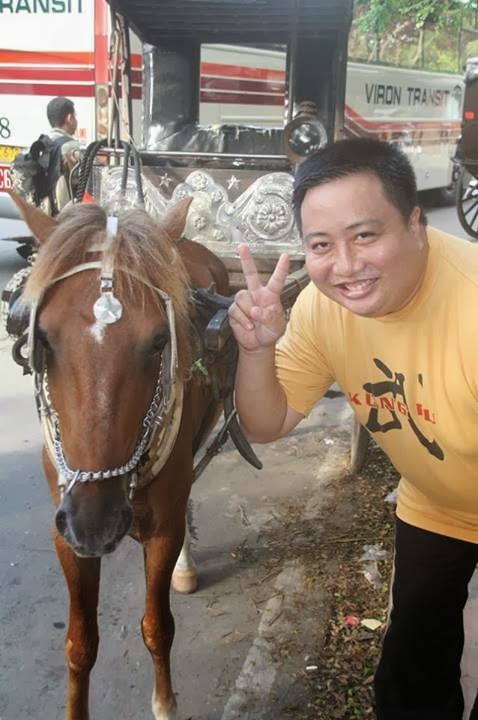
This poor fellow must be terrified because he thinks I am going to ride his calesa! 

Look Ma! I made a new friend! What do you mean he's an ostrich?! 

Rommel was enjoying Balwarte until he realized Chavit had enough money for dinosaurs too. 


Fr. Willie saved the best for last and drove us to an eatery for a taste of the famous Vigan Empanada. It rained in the evening, which meant that we were not able to visit the renowned Crisologo street of Vigan. That had to wait until the next evening.

Day 2:  Vigan to Sto. Domingo, and Vigan to Narvacan

 We woke up at 5 to make it to the 6 AM mass presided by Fr. Willie. We had breakfast afterwards and went on a short drive to Sto.  Domingo, around 8 kms away, to Benigno Soliven Academy, where more than 300 students were waiting for us. Mr. Lopez talked about the sanctity of life, and how life is both a gift to be cherished and a treasure to be nurtured so that eventually we can share this gift to others through the talents we develop. These talents, in turn, will give us an indication of what career to pursue after college. One student revealed to the whole crowd that she wanted to pursue her studies in college in Baguio, but she was being pressured by her friends to stay behind so they can always be together. Mr. Lopez told her and the all the students that true friendship transcends distance, so you will always be friends where ever you go; and that true friendship means you and your friends are free to pursue whatever will make you happy and fulfilled, including pursuing your dreams – even if it meant that you might spend less time with one another.
Ms. Anna Cosio expounded on the idea that our lives are suppose to be selfless and self-giving, giving our young ones especially on the matter of chastity and purity. She also emphasized the importance of dressing appropriately, being a gentleman and a lady, and  the benefits of living a chaste life.

At Benigno Soliven Academy

Juan Carlo sharing his thoughts on a question posed by a student

Ate Anna bakit ang ganda-ganda mo? 


posing with the 3rd and 4th year students of BSA

We went back to Vigan after lunch, but promptly took the 31km trip to Narvacan Catholic School run by the Reparatrix Sisters. After the discussions, we were met by a most curious question from one of the students: Bakit masarap ang bawal? (why does it always feel good to do the bad thing, roughly translated )
Ms. Cosio’s answer was nothing short of brilliant: that it is a mistake to think that all the good things in this life can only be achieved though doing what is bad or evil. In fact, that was the original spiel of the devil during the temptation of Adam and Eve: that doing something against God is not only good, but also beneficial. Anna explained further that there are consequences in doing good and in doing evil, and that usually it is the consequences of doing evil that isn’t being advertised openly, e.g. if you eat too much, you get sick. Have sex with a lot of partners and you get STD.

At Narvacan Catholic School

"Bakit masarap ang bawal?" 

after our talk at Narvacan Catholic School

As we drove home to our base in the Arzobispado of Vigan that afternoon, we saw this great sign:

Where can I run from your love?
If I climb to the heavens you are there
If I fly to the sunrise, or sail beyond the sea
still I find you there...

Was it a sign of approval from God of what we were doing? I have personally been through a lot of problems, and after being so overwhelmed with what I saw I realized that God was telling me that no matter what I went through, He was always there for me. For all of us.

Back in Vigan, we enjoyed good weather, which allowed us to visit the famous Crisologo Street, the UNESCO World heritage site. It was a street straight out of the Spanish times where (almost) every house was preserved in its beautiful antiquity. Even the road made of stone is preserved. At night, the magic begins as you are transported back in time as the calesas transport people and the lamp posts illumine the streets with romance and melancholy. We strolled around, took pictures, went for a calesa ride, and had beer and pizza in a restaurant along Crisologo street as a nightcap.

The beautiful Anna and the beautiful Dancing Fountain

Seems like my kind of place. 

another shot of the dancing fountain

Juan Carlo @ Crisologo Street

Speak the Truth! Vigan Edition

Very captivating fountain.

The allure of Crisologo Street in Vigan, a UNESCO World Heritage Site


Beautiful people in a beautiful place

And they don't call it Heritage City for nothing! 


Day 3: Vigan to Sta. Lucia, Sta.Lucia to Sta. Cruz
We had to wake up even earlier in order to make it on time to our talks in Sta. Lucia, 68 kms away from Vigan, then from Sta. Lucia we went to Sta. Cruz, 12 kms away. The church in Sta. Cruz was almost filled with students, with an estimated 600 youngsters. Ilocano students tend to be more reserved and shy than their counterparts in the big cities of Manila; however, what struck us was that the schools were spick and span, way cleaner even with our standards here. Perhaps cleanliness is a common Ilocano trait. It is a trait that everyone should imbibe. We also realized that the Ilocano youth behave in a more dignified manner than the ones here in Manila. They laugh if there is something funny, they cheer on for their companion if necessary, but there is hardly any hooting or boisterous behavior on their part.


Speaking in a packed church. God bless us all! 

Funny how these kids are so bashful.

My talk to these young ones was about their lives as their journey. I myself made mistakes before, as I admitted to the kids, and it was during those times that I felt so lost, without any compass guiding me. I spent three years living in sin, not going to mass nor even praying during those times. In my journey back to God, however, I realized that it was God who made the first step to come back to me and look for me. Then I told the students about the rainbow we saw yesterday. That rainbow, I said, was God’s way of telling me – and telling the youth – that whatever comes our way in life, with God’s strength we will be able to weather any storm and endure any hardship.

It was an uncomfortable trip that afternoon going to Cervantes, a sleepy little town up there in the Cordilleras  (elevation around 1,500 feet) with a population of no more than 20,000 people. The drive was a long trip where the road kept twisting and winding, lasting for close to three hours. It was like a trip from Manila to Quezon Province, except that the road was steep at times and turned left, right, and sometimes turned U every 6 seconds.

We arrived that evening at St. Agnes School and were greeted by the community of nuns that run the school. During dinner, the nuns told us how excited the students and the teachers were when they learned that we were coming, but the grade 7 and 8 students were quite disappointed because the talk was only for the senior high school students. Mark 6:34 came to mind: “And Jesus going out saw a great multitude: and he had compassion on them, because they were as sheep not having a shepherd, and he began to teach them many things.”

I decided for the group that we were going to have to go home a little bit later than usual to accommodate the lower grades. We hit the sack early due to exhaustion, and the cool Tagaytay-like weather was the perfect lullaby as we gave way to sleep.

Day 4: Cervantes

The students in St. Agnes may be more isolated than the other students in Nueva Segovia, but they sure are the most jovial students so far. We were met by warm smiles and greetings by the students we encountered, and the small ones must have mistaken me for a priest. They kept greeting me “good morning father!” and making mano.

A captivated audience hangs on to our every word! 

I have absolutely no idea what that sign said. 

One does not simply go to Ilocos Sur and not fall in love with the place! 

A student from St. Agnes asks Anna a question

Anna interrogating a student. 

One of the students from the senior batch asked if those who engaged in same-sex marriage did feel true love for their beloved. Since I opened the talks with the topic of our person-hood as a gift from God, and that we should all share this gift to the world – I told him that marriage is very much an exchange of gifts – the man gives his masculinity to the marriage, and the woman brings her feminine side. The complementary gifts allows God to give them another gift: a child that is supposed to be a gift to the whole world too, enriching all of us in the process. What happens in same-sex unions is that the person receives a gift he or she already has: a man receives masculinity, a woman receives femininity. Not only does the gift seem useless (ever received too many mugs for Christmas?) but the purpose of the giving of the gifts is lost too – as this union will never bring forth another gift, biologically speaking.

During lunch, the nuns told us that they found something peculiar – that we treated one another like brothers and sisters.I told them that we really treat each other as such in F4L.

The whole community was so profuse in their gratitude that they made us bring along a whole box of vegetables they had grown – Baguio Beans, potatoes, and cabbages. Enough to make me put up my own stall at the local market here and sell them in the morning and still have enough to cook for lunch and dinner. As we went down the mountain, we saw for ourselves the breath-taking view of the Cordillera mountains in Ilocos Sur, leaving me awestruck for the nth time in 4 days.

Fr. Willie, Anna, and I pose at Bessang Pass on the road going to Tagudin from Cervantes.

My God and my all, how I long to love you...

Posing at another spot. Believe it or not behind us was a drop of hundreds of feet. 

Jumping for joy! 

Juan Carlo poses for the record! 


See the long and winding road behind us??? That's almost 3 hours of twisting and turning! 

We had dinner at a local parish in Tagudin, south of Candon, and after that we caught a bus going to back to Manila. Before we left, I told Fr. Willie that it was a pleasure serving God and his people here in the Archdiocese of Nueva Segovia. I also told him that we will definitely come back.

We arrived at the terminal in Pasay around 4 AM. I went straight to the Pro-Life office to work as I was worried that if I went home I couldn’t muster the strength to get up and go to work. I was tired, exhausted, but at the same time my spirit was refreshed. Building the Kingdom of God here on Earth seems to be an impossible task, but it’s worth the try.


Thursday, October 24, 2013

Old School Rules: Preserving Purity in the Seminary

Many think mistakenly that seminary life is very dull, and yet our experiences inside those walls make really great stories up until today. Today I am writing about how we kept the virtue of purity inside the seminary. In a place where you have more than 100 hormone-raged teen-agers, trouble could really happen if the superiors were not prudent. We therefore had some of the strictest rules that were aimed at preserving purity back then, whether we knew their real intention or not. If many of you would find the rules a little too harsh, or perhaps even comical and outrageous, take note that I went to the seminary back in the 90s. Imagine what they did back in the 60s, 70s and 80s!


Parents, teachers and educators, and those involved with the formation of the young should take note. Weird as the rules might be, they got the job done!

1. No Green Jokes - This was one of the first of the unwritten rules in the seminary I learned the hard way. I cracked a green joke the first time and I didn't even get to finish it as I noticed the Brother assistant gave me the dagger look. It's not that there were no green jokes being passed around, but it's not being said out in the open, and those who spread them lived in infamy as the "bad talk" guys, long after they have stopped telling green jokes. Trust me on this.


2. Pants - We covered our legs like we were ladies with killer legs. Seriously, the only time we wore shorts were during games. After games, we had study period for the rest of the afternoon and evening, and still we were asked to wear pants. It used to be a rule too, that you can't wear shorts at night - yes, you have to wear pajamas, and the mosquito net was a necessity. They drove away mosquitoes, and did not give others a clear view of the person inside.

good thing we didn't have to wear a banana suit back then.

3. Dorm Rules - There were no rooms where you could close the door and not be seen by the assistant. Instead we had a big dorm that could accommodate 40 or more beds at a time. There was a dim light in the dorm during sleeping times, dim enough so you could sleep, and at the same time keeping the dorm lit enough for the assistant to see everyone. We were also taught to use our towels as "tapis" for cover whenever we pulled down our pants to change into sports gear or pajamas or to head to the showers. Strictly no showing of underwear.

There is also this rule about one's private space, the space between your bed, in front of your small cabinet, and the next bed; that is your personal space, a space which cannot be trespassed by any person except during cleaning time. We also had what we call a Sacred Silence in the dorms. Basically we kept the silence in the dorm like we kept the silence inside a church, which meant that we didn't talk nor converse with one another there. The only time we did was during times of necessity, like when you run out of toothpaste or shampoo and have to ask your neighbor to give you some, and even then the transaction was done whispering, without invading any personal space.

4. Fast-paced Spartan Lifestyle - Seminary schedule was tight, as we followed the mantra: " Idleness is the workshop of the devil." There were very few moments where we did nothing. We were woken up at around 5, we had mass at 6, breakfast and chores at 6:30, classes at 7:15. After lunch, no siesta, as the Salesians would always say that Don Bosco himself never took naps, and there were 2 or more hours of manual work instead. Games follow, then showers, then study until the evening. Shower time was fast - only 15 minutes to take a bath, do your laundry, and get dressed for study period. The first time I went home after living in the Juniorate for some months, my mom laughed at how I was able to take a shower in under 3 minutes.

I heard from my former seminary superior that the seminarians in the 60s had it even stricter. The boys would all go inside the shower cubicles at the same time, and there was only one shower faucet which the assistant controlled, and he would turn the water on, then off for the boys to soap, then on again, then off for the shampooing, then on again - very precise, like clockwork, shower was over in under 3 minutes. Whether true or not, I am thankful we weren't that structured in the 90s. The rationale was that shower time was the time many young boys masturbate. Less shower time, less chance to do it.


We were taught to walk the "Salesian Walk" which was a brisk walk more than a leisurely pace, and we did this all the time. Food intake was regulated, as it is believed that mastery of the appetites was a way to increase spiritual fortitude against temptation. And it's not like you're allowed to keep food for yourself too, much less hide them. I remember being so hungry once that I feasted on a contraband sachet of ketchup from McDonald's as there was no other edible item around.

Ketchup. Yum.


5. No Touching Whatsoever - It's one thing to have a close friend, but it's another to put your hands on the guy. That's a big no-no. We weren't allowed to touch another person unless it was a hi-five or a handshake. Another taboo was to put your arms around another guy, as harmless and innocent it may look. In dealing with issues of purity, sometimes nipping things in the bud is the best way to go.


6. No Particular Friendships - this means you have to spend time with everyone, and not be friends with just one guy. This is a standard seminary rule, and the rationale was that everyone was supposed to be equally friend and brother. Having particular confidantes or allies was feared to cause factionalism. Besides, if you spend too much time with just one buddy, chances are you will be under suspicion that there is funny business going on between the two of you. This rule also avoided the danger of homoerotic temptation. There is also the rule of small boys (1st and 2nd year high school) were not allowed to mingle with the big boys (3rd and 4th year), for fear that the big boys would take advantage of the small boys' relative innocence. 


7. The Culture of Excellence in Sports -  Why? Because engaging in sports made us manly, and the more we played the less idle we were. When were freshmen, we literally worshiped the guys below. 


Don Bosco Juniorate Football Team, '93-94

The Juniorate was full of stories about our predecessors' exploits and excellence in sports, especially in football; how the older batches played a variety of opponents in football, including the army and some expats who regularly visited the Juniorate if they wanted a real challenge. We looked up to the varsity members and strove for our own excellence in sports initially by patterning our skills with the older aspirants we idolized. Heavy rains were not an excuse to not play - instead we played War Games, a modified version of dodge ball, under the pouring rain. There were very few of us who did not look forward to game time in the afternoon.Sports took our minds away from any temptation the devil prepared for us, and re-channeled whatever sexual feelings we had into something more appropriate for our age and situation. 

8. No TV, No Radio, No Comics - This was enforced so as to detach us from the worldly secular media. Absolutely no comics either. And if you brought a book with you from home, you have to let your superior read and inspect it first. During our time - the nineties - it was particularly difficult to not listen to music. The Eraserheads were becoming famous, as well as other famous bands, foreign and local, like Nirvana, The Cranberries, The Teeth, etc. Who could forget the ass-chewing we got from our principal, Fr. Osial, after he heard Michael Sacay sing "Pare Ko" - the cussing version?  
The song everyone was secretly singing.

9. Priests are always ready for your confession - This is one thing I have gotten so used to: the availability of our Salesian priests to hear your confession. Fr. Balocco waiting outside the study hall during study period for aspirants who wanted to go to confession was a familiar sight. Fr. George Schwarz was always ready for your confession, and no matter how busy he was, he will put aside what he was doing in order to attend to the needs of your soul. The Salesians walked the talk when it comes to Don Bosco's familiar quote: Give me souls, take away the rest.


Tuesday, October 22, 2013

The Greater Tragedy

(Reposting from the original post at Pro-Life Philippines - yes it's the same article because I wrote that too.)
Stories and rumors from the rubble and devastation in Bohol:


Friday, October 18, 2013

Top 5 Movies that Influenced Me To Be Who I Am

There are good movies, and there are great movies. But in another category by itself are the movies that stayed with you long after you left the cinema, and have influenced or formed your convictions and morals. Here is my list of the Top 5 movies that have created a profound influence in my life, so much so that I refer to these movies, and scenes in these movies, whenever I need motivation. Take note that these movies aren't necessarily award winners; for some reason, they just have a special place in my heart. Here they are, in no particular order.

1. Alive (1993) - Based on Piers Paul Read's 1974 book: Alive: The Story of the Andes Survivors. This gripping tale of survival tells us the story of an Uruguayan rugby team whose plane crashed in the Andes en route to their match in Chile. The team spent several months on top of the mountain, and had to resort to eating the flesh of their dead companions just to stay alive. They were finally rescued after two of them mustered enough courage, strength, and food to make the journey out of the mountains and call for help.

This was one of the first movies I watched as a seminarian back in 1993, and it taught me a very valuable lesson: never give up, despite one's circumstances, and always persevere. Whenever I am sick, or in pain, or going through a lot emotionally and physically, I remember this movie and tell myself: pull yourself together! If they could survive the Andes, you could survive this!

Memorable quote: "There's nothing more to say. We were brought together by a grand experience."


2. A Love Story (2007) - Starring local stars Aga Muhlach, Maricel Soriano, and Angelica Panganiban, it tells the story of a man searching for love, not only from women, but from his family as well. This film addresses several issues on different levels, and those with relationship and family issues who seek counseling may find answers and perhaps even healing and closure in this brilliant film.

I watched this movie a year after it was released, during the time when I was also seeking love and attention, and have been involved in a string of bad relationships, destroying many friendships and relationships along the way. Needless to say I cried a lot while watching because that time I was able to relate to the main character:

Memorable Quotes:
Aga: Mahal mo ba ako?
Maricel: Sobra...kahit alam kong hindi na tama...
Aga: Mahal na mahal kita, akala ko sapat na 'yun para makalimutan mo kung tama 'to o mali...


3. The Mission (1986) - This film tells us the experiences of the Jesuit missionaries in 18th century South America. Directed by Roland Joffe, the highlight of this movie is the spectacular scenery of nature that is perfectly captured in music by the brilliant Ennio Morricone. The movie centers around the Jesuit priest Father Gabriel, played by Jeremy Irons, and Robert de Niro, who portrays Rodrigo and produces a once-in-a-lifetime performance. They sustain a mission area with the natives up in the mountains, only for their simple lives to be ruined by politics and greed. One of those classic movies I watched as a seminarian, I was deeply inspired to persevere in my life as a seminarian because of this flick. To this day this is the movie that motivates me to continue God's work here on Earth despite the obvious difficulties we face.

Memorable Scene: Rodrigo and Fr. Gabriel climb up the mountain to where the natives are as Rodrigo's penance for killing his brother and for hunting down and selling the natives. Tied to him are the instruments of his sins: his armor, his sword, and other heavy things. He struggles to climb up the slippery mountain but is determined to make in on top. When they reach the top, he is confronted by the natives, but to his surprise, the natives cut his baggage loose and throws it away to the river. He finds release and forgiveness from the very people he has oppressed. It is hard not to cry with De Niro in this scene.


4. Schindler's List (1993) - A must-see video for all pro-lifers. This is THE movie that steeled my determination to save lives through the pro-life movement. Oscar Schindler, played by the great Liam Neeson, is a Nazi party member who saved thousands of Jews from the Holocaust by employing them in his factory.

Memorable Scene: The last scene were Oscar frees his Jews and tries to escape capture. He was given a ring by the Jews where it was inscribed: Whoever saves one life, saves the world entire. His breakdown in the end is the only time he has shown any strong emotion in the movie and will leave you absolutely gutted. Leave it to tough men crying to make you weep like crazy.


5. Kingdom of Heaven (2005) and Braveheart (1995) - Although Kingdom of Heaven had some obvious anti-clerical and anti-Catholic swipes here and there, Kingdom of Heaven and Braveheart have inspired me to fight for what is right, no matter how small or insignificant you are to your enemy. If Schindler's List solidified my intent to become pro-life, these movies fan the fire in my belly to fight injustice and to protect the weak and the innocent.

Memorable quote:


There you have it. My top 5 greatest influences in movies. I hope we never underestimate the power of a good movie. These movies will stay with me forever. Let's do our part to shun bad movies and share the good ones to our fellow Catholics and friends.